Dorset day two, 16 Oct 2010
Day two Itinerary
|
10:00 – 11:00 |
Charmouth Visitors Centre and fossil shop. Walk on path to see erosion features and beach for fossils. |
|
11:30 – 14:00 |
Visit “ammonite graveyards”, lunch at Lyme Regis. Optional visit to local museums; Mary Anning connection. |
|
14:30 – 17:00 |
Burton Bradstock; sandstone cliffs and fossil beds – further development of sedimentary sequence. |
In-depth information from the rest of the web
The fossils of Lyme Regis, click here.
The fossils of Charmouth, click here.
The geology of Charmorth to Lyme Regis, click here.
The geology of Lyme Regis, click here.
The geology of Burton Bradstock area, click here.
Write up of day two by Elaine Tilley
The sun was shining and the blue sea reflecting the sky so we had a perfect day to view the Jurassic Coast. After setting off we looked back and saw Chesil Beach stretching out in the haze.
The rocks of this World Heritage Site dip gently east with the oldest Triassic in the west, then the Jurassic followed by Cretaceous in the east. This represents a walk through time of about 185 million years or so over 95 miles of coastline.
The morning was spent at Charmouth and Lyme Regis, an area that was home to Mary Anning (1799-1847) famous for being the original local fossil collector. I plan to return to find out more about her!
At the cliff top at Charmouth we saw marathon runners start their race along the coast eastwards. What a sight they made and how easy it looked to run along the beach. We saw spectacular evidence of cliff erosion but we did not find so many fossils as the end of the holiday season is not a good time to make finds, especially if the weather is mild and the cliffs have not been under recent attack by wind and waves. Good views of the Golden Cap gave us evidence of the unconformity in this area.
At Lyme Regis we looked east toward Black Ven site of recent mudslides. In the town we had a lunch stop, then suitably clad in yellow helmets set off hopefully for the “ammonite graveyard”. We walked below the cliffs towards the Cob and saw layers of fossiliferous strata.
Going further east to Burton Bradstock there was more evidence of sea erosion but with the sea lapping gently we had to imagine the storms that erode the cliffs with pea size pebbles. The National Trust owners and carers of this stretch of coast do well to recognise an area that has unique geological features extending inland with undulating valleys and scarps mirroring the soft and hard rocks.
Pictures from day two
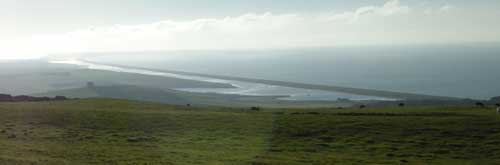
Chesil Beach and The Fleet in the morning sun. Viewed from Abbotsbury Head.
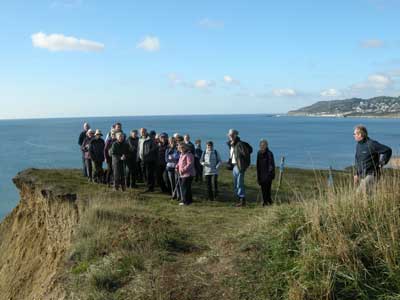
The group above the landslip just East of Charmouth, Lyme Regis behind
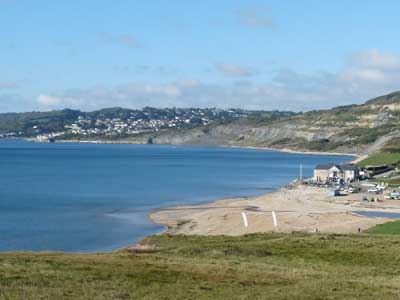
View of the bay, Charmouth is in
the front, Lyme Regis behind.
The rocks here are early Jurassic from the Lias Group, 180 – 200
million years old.
From Charmouth there is a landslip of Black Ven Marls.
After that, approaching Lyme Regis, we see Blue Lias rock.
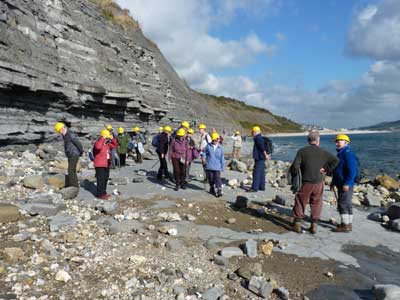
The group looking for fossils in
the Blue Lias rocks just West of Lyme Regis.
The alternating layers of limestones and shales in the Blue Lias are clearly
visible here.
The word “Lias” is a corruption of the word “layers”.

A fossilised ammonite on the beach at Lyme
Regis.
Note the 50p coin above for scale.
There were hundreds in the “ammonite graveyard”.
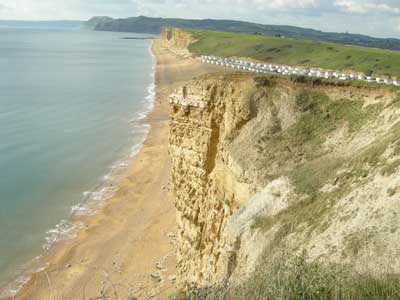
View West of Burton Bradstock
towards West Bay.
This area marks the transition between Middle Jurassic and the
Lias Group, about 180
million years ago.
The main cliffs are Bridport Sandstone,
showing differential banding.
These are capped with a paler inferior Oolilic Limestone,
laid down in fresh water.
This limestone is fossil rich.

The group searching for fossils
below West Cliff (between Burton Bradstock and West Bay).
The Oolitic limestone which caps the cliffs is removed in storms, and is fossil
rich.
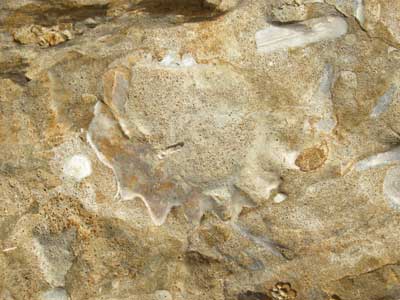
Fossilised oyster in the Oolitic Limestone. West Cliff.

“Snuff Boxes”, West Cliff”.
This hard grey limestone is irregularly iron stained on the top.
The limonitic concretions
are commonly known as “Snuff Boxes”.
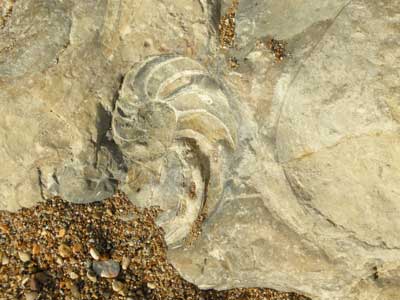
Nautilus fossil in the Limestone. Approaching Burton Bradstock.